

Talking about the photovoltaic support industry
May 12, 2022
Basic Situation
The photovoltaic support is called the "skeleton" of the photovoltaic power station, and is a special structure designed and installed in the photovoltaic power generation system to support, fix and rotate the photovoltaic modules.
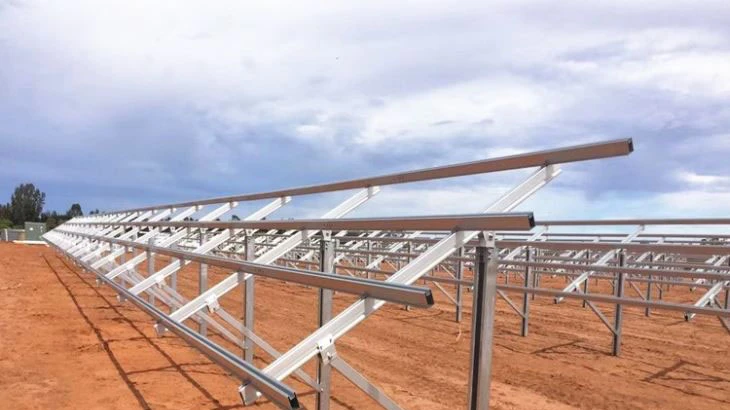
Photovoltaic brackets are mainly composed of columns, main beams, purlins, welding parts, foundations, etc. According to whether the angle can be freely adjusted in the later stage, they are divided into fixed brackets and tracking brackets. The adjustable tracking bracket has more rotation system, driving system and control system than the fixed bracket. In the development, the tracking bracket has developed a plane single axis, a tilted single axis and a double axis.
From the point of view of power generation efficiency, the tracking bracket can obtain more solar radiation with higher efficiency. The additional hardware, software and construction and maintenance also make the cost of the tracking bracket higher than that of the fixed bracket.
Industrial Chain
Photovoltaic brackets account for 10%-20% of the system cost, and its technical level and performance directly affect the power generation efficiency and investment income of photovoltaic power plants.
The photovoltaic support is located in the middle reaches of the photovoltaic industry chain, and forms the core of photovoltaics with photovoltaic modules, inverters, combiner boxes, cables, etc. The upstream is steel and other metal materials and electromechanical components, and the downstream is photovoltaic power plants.
The common materials of photovoltaic brackets are mainly aluminum alloy, stainless steel, galvanized steel, etc. Aluminum alloy is generally used in civil buildings, and galvanized steel is the most widely used at present, mainly using galvanized steel as the main material.
Generally speaking, downstream customers are investment owners or general contractors of power plants, and generally establish long-term and stable cooperative relations.
Market and Company
The market demand for photovoltaic brackets depends on the newly installed capacity of the photovoltaic power generation market. At present, fixed brackets occupy most of the market share due to stability and low up-front investment costs, but the application of tracking brackets is expected to become more and more popular.
At present, the domestic proportion of the tracking bracket industry is only about 10%, which is far lower than the main link of photovoltaics. In addition, the threshold for tracking stents is high, and the pattern is relatively concentrated compared with the stent industry. The leading technology and cost advantages are significant, and the industry concentration is expected to be further improved.
Photovoltaic brackets need to be combined with the topography, climate and solar resource conditions of the construction site, and properly arrange the orientation and spacing of photovoltaic modules, so that the photovoltaic power station can achieve the best power generation efficiency.
From the perspective of the production process of the bracket, the fixed bracket needs to consider the two aspects of address and land reuse. The tracking bracket needs to be highly customized, and it must also meet the standards and specifications of construction, machinery, electricity, etc., and additional electricity needs to be added. Control design and drive design are two links, and electrical specifications and software design need to be considered in the design.
Several Points of View
The photovoltaic industry is still in a period of rapid development. As a special equipment in photovoltaic power generation systems, photovoltaic brackets will continue to grow in the future.
Photovoltaic support does not seem to be a very high-tech industry, but stability is particularly important. Once a problem occurs with the support, the loss to the photovoltaic power station is particularly obvious compared with other links. There are still many thresholds for tracking brackets, such as wind tunnel testing, control, algorithms and applications.
With building-integrated photovoltaics (BIPV), photovoltaic mounts are also evolving.
The stent has a long life cycle, and the transportation cost accounts for 4-5% of the product price, which has obvious regional characteristics.
The consideration of tracking brackets and fixed brackets mainly depends on the benefits. The current domestic penetration rate of tracking stents is much lower than that in Europe and the United States. When purchasing downstream, it often requires the endorsement of past successful projects, and the industry concentration will continue to increase.


