Design solar panel bracket
Jul 15, 2016
Design solar panel bracket
Abstract: The solar panel is an important component bracket fixed solar panels
Design solar panel bracket
Solar panel bracket definitions
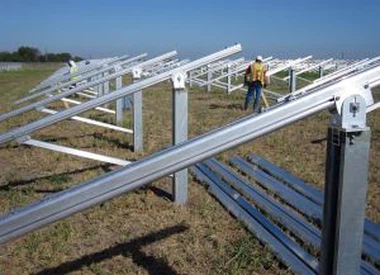
Solar panels are an important component of the stent fixed solar panels, under the premise of obtaining the maximum power generation efficiency of solar panels, to ensure safety and reliability of the stent is PV module manufacturers need to consider and study. According to the needs of different forms of solar power systems are generally divided into single-column bracket Solar mounting, double column solar stent, solar support matrix, rooftop solar stent, solar wall bracket, tracking systems, etc. Several series supports standard models, at the same time according to different installation is divided into ground-mounted systems, roof installation system and integrated EEB bracket system.
2. Solar panels stent design
2.1 solar panel support structure
Currently commercially available solar panel can not adjust the angle of the mounting bracket are mostly used to track the way solar power generation and waste a lot of manpower and material resources, input-output ratio by a certain degree of limitations. This paper presents a different latitudes can be adjusted according to the angle of the solar system a bracket system can adjust the horizontal angle according to need, not only to adapt to the use of terrestrial photovoltaic power plants, but also can be used in rooftop solar power station, during the installation process You can quickly adjust the angle of the stent, the stent avoids conventional PV modules can not quickly adjust the angle of the shortcomings, while the component stent using high-carbon steel, hot-dip galvanized surface materials, low cost, high strength, corrosion-resistant material selection strong, it can be used in relatively harsh environment areas. This system includes a main frame triangle 1; supporting connection mechanism 2; scale puck 3; positioning holes 4; plunger pin 5 graduation; pallet 6; platen 7; bearing sleeve 8; connecting rod 9; 10 foot support. The system main stand triangular welded structure, the structure is simple and can withstand sufficiently a load, the battery pack is connected by means of bolts in the support means, supplemented by the angle adjustment dial. Scale by the plunger pin fixed scale puck, plate, plate, bearing sleeve with the puck scale use, connecting rod and the foot support brackets used to increase the strength of PV modules.
2.2. Solar panel bracket connection
When solar panel system installation, bolted through the embedded base, as shown in FIG. Foot supporting the bottom bracket into cradle bolted to the base, and then install the solar panels, solar panels bolted to the support mechanism 2, the angle desired by the scale positioning plate positioning pins 3 and 5 regulation, after the completion of install the next group. When connected solar power matrix, two adjacent modules bracket 11 is fixed by fastening tablet to enhance its strength.
2.3 solar panel bracket Material Selection
Current solar PV mounting system of the widespread use of the material from the points, there are three concrete frame, steel frame and aluminum frame and so on. Concrete support mainly used in large-scale photovoltaic power plants, because of their self-important, can only be placed in the field, and a good basis for the region, but high stability, can support the huge size of the panels. Aluminum frame is generally used in civil rooftop solar applications, aluminum alloy corrosion resistant, light weight, durable and attractive features, but its low capacity, it can not be applied in the solar power plant projects.
This design of this steel bracket stable performance, manufacturing processes mature, high load carrying capacity, easy installation, excellent corrosion resistance, aesthetic appearance unique connector design for quick installation, the installation tool is simple common structure coating material using steel and stainless steel zero parts, service life of 20 years.
2.4 Analysis of PV modules support load
Stent strength including fixed computing load (own weight and other components), wind load and snow load, wind load refers blowing from the front bracket (downwind) wind pressure and blowing from the rear bracket (wind) wind pressure caused bending strength and the amount of material support arms buckling (compression) and the tensile strength and the normal ground, shake roofs, structural changes caused by subsidence.
2.4.1 snow load stress analysis
Snow load weight formula: S = Cs * P * Zs * As (2-1)
Where S is the snow load, Cs for the slope coefficient, P is the average unit mass of snow (snow 1cm equivalent mass, an area of 1m2 quality) generally place more than 19.6N, snowy region over 29.4N. Zs perpendicular to the ground deepest snowpack (cm), As for the snow area. Solar array column surface design with a set amount of snow on the ground perpendicular to the deepest snow cover (Zs), however, reduce the amount of snow plows often the case, depending on the situation can be reduced Zs value.
Winds load 2.4.2 Stress Analysis
Solar panel bracket check this design wind speed in ten wind (27m / s) of strength, deflection meets the requirements.
2.4.2.1 Positive stress check
Solar panel bracket unidirectional beam when subjected to bending, the normal stress equation: σ = M * γ / Wz
Where Mx is the same cross-section beam bending moment maximum rigidity plane (x-axis); Wnx for the net section modulus (flexural section modulus) x axis; steel for the strength design value. According shown in Equation 2-2 to give the normal stress
The investigation is designed to investigate Hardware Manual Table [f], σmax <[f] so meet the strength requirements.
2.4.2.2 be checked for deflection
The maximum deflection of the beam span:
Where l0 is calculated beam span; S is the load in the form of the support case related to Uniform Load Charpy S = 5/384; E is the elastic modulus; M is the maximum span moment; EI is sectional flexural stiffness. Longitudinal calculated above.
2.4.2.3 After stretching and compression strength of the support arm
2.4.2.3.1 upwind occasions
W wind pressure load on the support arm stretching from the load effect, blow into the load (Yang Li). Tensile stress is shown in Equation 2-5 ::
Where P is the tensile force; A is the cross-sectional area of the support arm, look-up table Q235 steel tensile strength design value [f], <[f], so there is no problem.
2.4.2.3.2 downwind occasions
When the bracket assembly and cross-sectional width relatively long length of the pillars upon receipt compression, bending failure probability is higher than the compression failure. This is known as buckling column, when a load is called buckling load. Buckling load (Euler's formula) as shown in Equation 2-6:
The formula for the buckling load; the axial cross-sectional moment of inertia; factor supporting conditions across the grounds of the decision, the case hinged at both ends of the hinge 1; longitudinal elasticity coefficient of the material; L axis length. Tension and compression strength of the front support of the calculation process with the rear support.
3. Application Prospects
The current international energy situation is relatively grim, countries are struggling to find alternative to conventional fossil fuels new energy. Further nuclear power raises questions about security, subject to geographical and seasonal wind hydro greater impact, however, solar energy as inexhaustible, with absolutely no concern for clean energy and use it. With the widespread adoption of global large ground, rooftop solar power generation systems and applications, solar power has become one of the essential sources of power generation in the power supply, and in order to ensure the photovoltaic module systems reliable, secure, stable operation, must require solar each member of the panel has a good wind, anti-snow pressure, corrosion-resistant properties. This design of solar panel bracket not only meet the wind, anti-snow pressure, corrosion-resistant properties, and can fit on the ground matrix solar rooftop solar systems. This solar panel bracket has a good prospect in the future photovoltaic applications.
Based on the disadvantages of the conventional solar panel bracket, combining solar power generation characteristics, we designed a new type of solar panel bracket. The unique design of the structure so that the PV module assembly has a branch can be adjusted according to different regions and angles, which can make full use of the local solar energy resources, to achieve the maximum power generation efficiency of solar panels. At the same time the connection of PV modules, material selection and support load stress analysis to detailed analysis and practice, it has a good seismic, wind, anti-snow pressure, corrosion resistance, physical properties, so that the application of solar panels in the broader region.