

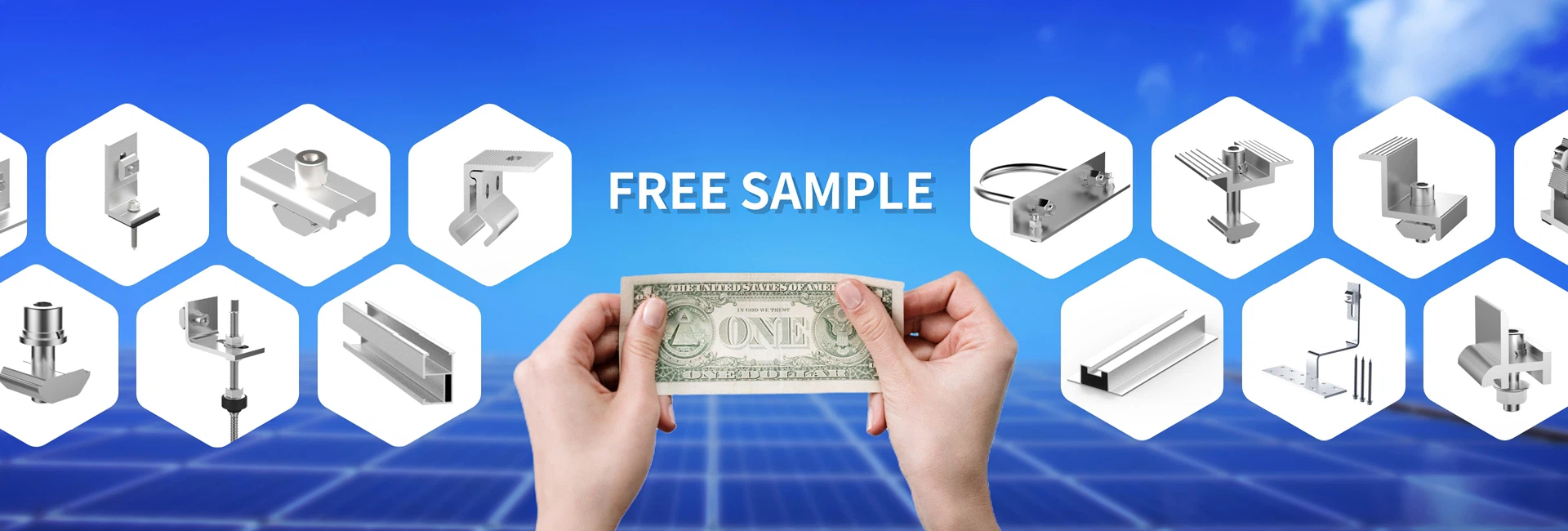
Aluminum alloy sloar support manufacturing method
Oct 16, 2018
The utility model relates to a bracket, in particular to an aluminum alloy solar bracket。

Background technique:
The adjustment of energy structure is the choice of the national strategic level. Environmental protection has become a social issue. In the future, the trend of the country to vigorously promote the construction of new energy and renewable energy is irreversible. Solar energy has been widely used as a new type of energy source. Photovoltaic power station is an important aspect of solar energy utilization. The installed capacity of distributed photovoltaic power plants is generally small, the initial investment and post-operation and maintenance costs are low, the construction period is short, the nearest power supply can be realized, and the complementary and alternative to the large power grid and long-distance power supply can be formed, and the construction of the micro-grid can be promoted. And development.
As a support and fixture for photovoltaic modules, photovoltaic supports are widely used in the construction of solar photovoltaic power plants. According to the material, there are three kinds of concrete, steel bracket and aluminum alloy bracket. The aluminum alloy bracket is corrosion-resistant, light in weight, beautiful and durable, and is especially suitable for use in a household inclined roof photovoltaic power generation system. At present, the aluminum alloy guide rail is mostly 6 meters, which is very inconvenient in the packaging transportation process and the secondary transportation of the system, which causes great trouble to the construction and installation. Some photovoltaic power generation system integration manufacturers cut the brackets and sent them to the project site according to the design scheme of each household photovoltaic power generation system. The materials preparation work in the early stage is long, and the problem of long guide rails cannot be avoided. Dividing the bracket rail into 2 to 3 meters, and assembling it with the bracket connecting strip and fastening screws to the site, can alleviate the difficulty of the bracket in packaging and transportation to a certain extent, but the material cost and construction cost increase.
Chinese patent CN 203968040U discloses a novel multi-purpose photovoltaic bracket device, which is mainly applied to color steel tile roof, including at least two card slot type guide rails, photovoltaic components, several fasteners and seaming fixtures, and card slot type rails isometric Parallel distribution, each card slot rail is mounted on the seaming fixture by fasteners, and the photovoltaic component is inserted into the groove of the slotted rail. The photovoltaic bracket device is convenient and quick to install, and has low cost, but is limited to use on a color steel tile roof, is not widely used, and the bracket system components are relatively complicated. The utility model optimizes the structure design of the bracket, selects appropriate size parameters, and the bracket assembly is simple and easy to obtain. By rationally arranging the photovoltaic bracket, the mechanical performance of the support system is improved, the cost of the photovoltaic power generation system is further reduced, and the photovoltaic is beneficial. Use and promotion.
Technical realization elements:
The purpose of the utility model is to overcome the defects of the prior art and to provide an aluminum alloy photovoltaic bracket with simple structure, low material cost, convenient packaging and transportation, quick construction and installation, and safe and reliable performance.
The purpose of the utility model can be achieved by the following technical solutions:
An aluminum alloy photovoltaic support, comprising a roof hook, a bracket rail, a double side clamp and a one side clamp,
The roof hook is fixed on the roof by the expansion screw, the bracket rail is mounted on the roof hook, and the double side pressing block and the one side pressing block pass through the tightness The fixing screw fixes the installed photovoltaic module on the bracket rail. The materials used are very conventional commercially available materials and are very convenient to use.
The bracket rail is a 25-35 cm long aluminum alloy bracket rail. Preferably, 30 cm can be used. The aluminum alloy bracket rail has a moderate length and uniform specifications. It can be packaged and transported to the project site along with other auxiliary materials of the photovoltaic power generation system. The transportation is very convenient, and the product appearance packaging image of the photovoltaic power generation system is also improved.
In addition, the above length is the width of a conventional tile, which facilitates the positioning of the roof hook between the tiles, meets the installation requirements of different specifications of photovoltaic components, saves more than 60% of the aluminum alloy support rails, and reduces the construction of the household photovoltaic power generation system. cost.
The expansion screw is fixed on the roof cement foundation. According to the system design scheme, the arrangement of the photovoltaic modules and the size structure, the expansion screws are fixed in the middle of the adjacent two photovoltaic modules or the photovoltaic modules, so that the force points of the overall photovoltaic support system fall on the expansion screws, It is beneficial to improve the mechanical strength of the photovoltaic support system.
The double side compacts secure intermediate intermediate photovoltaic modules. When two adjacent PV modules are installed, the double-sided clamps are fixed in the middle of the aluminum alloy photovoltaic support rails, and the components are evenly distributed on both sides of the guide rails, which is beneficial to the balance of the rails and improves the stability of the bracket system.
The one-side pressure block fixes the edge of the left and right photovoltaic modules. When the PV modules on the left and right ends are installed, the part of the aluminum alloy photovoltaic support 2/3 along the edge is located under the component, and the 1/3 part is fixed to the one-side clamp to prevent the one-side clamp from sliding outward and falling. The stability of the photovoltaic support system.
If it is necessary to increase the capacity of the photovoltaic power generation system and expand the number of photovoltaic modules, the bracket rail can be moved outward to the intermediate position, and the one-side pressure block can be replaced by the double-side pressure block.
Compared with the prior art, the aluminum alloy photovoltaic support of the utility model has the advantages of simple structure, convenient packaging and transportation, low material cost, quick construction and installation, and safe and reliable performance, which is very beneficial to the application and promotion of the household photovoltaic system.
DRAWINGS
Figure 1 is a schematic view of a bracket rail;
Figure 2 is a schematic view of a planar structure of the roof;
Figure 3 is a schematic view showing the installation of a roof hook;
Figure 4 is a schematic view showing the distribution of roof hooks;
Figure 5 is a schematic view of the installation of the intermediate bracket rail
Figure 6 is a schematic view showing the installation of the edge bracket rail;
Figure 7 is a schematic view showing the distribution of the guide rails;
Figure 8 is a schematic view showing the fixing of the double side clamp;
Figure 9 is a schematic view showing the fixing of the one-side pressure block;
Figure 10 is a schematic view showing the installation of a photovoltaic module;
In the figure: 1-bracket rail, 2-roof plane, 3-roof hook, 4-expansion screw, 5-double side clamp, 6-one side clamp, 7-fastening screw, 8-PV module.
Detailed ways
Example
The present invention will be described in detail below with reference to the accompanying drawings and specific embodiments.
An aluminum alloy photovoltaic support comprising an expansion screw 4, a roof hook 3, a bracket rail 1, a fastening screw 7, a double side clamp 5 and a one-side pressure block 6, and the roof hook 3 is fixed to the roof plane by an expansion screw 4 2, the bracket rail 1 is mounted on the roof hook 3, and the double side pressing block 5 and the one side pressing block 6 fix the mounted photovoltaic module 8 on the bracket rail 1 by the fastening screws 7, and the materials used are very conventional. Commercially available materials, the bracket rails are made of aluminum alloy.
In this embodiment, a photovoltaic module is installed in a tiled roof, and FIG. 2 is a structural schematic view of a roof plane. Figure 1 is a schematic view of the bracket rail, the bracket rail 1 is cut into 30cm each, which facilitates the packaging and transportation of the bracket rail. According to the design scheme of the household photovoltaic power generation system, all the installation and fixing positions of the roof hooks 3 to be installed are determined on the roof plane 2, and the corresponding positions on the roof plane 2 are marked with a marker.
Since the roof tiles are stacked one by one, the mounting position of each row of roof hooks can be moved up and down slightly so as to be able to be fixed to the cement foundation of the roof through the overlapping areas of the upper and lower rows of roof tiles. The corresponding roof tiles are first uncovered at the corresponding signs, and then the pre-designed general-purpose roof hooks 3 are fixed on the cement foundation of the roof with the expansion screws 4, and finally the uncovered roof tiles are returned to the original position. Pay attention to the overlapping of the upper and lower tiles and the closeness of the overlapping of the left and right adjacent tiles to prevent the roof from leaking due to the uncovering of the tiles. Figure 3 is a schematic view of the installation of the roof hook, and Figure 4 is a schematic view of the distribution of the roof hook.
Then, the bracket rail 1 is fixed on the roof hook 3 by the fastening screw 7, and the middle bracket rail 1 is fixed in the middle; FIG. 5 is a schematic diagram of the installation of the middle bracket rail; the bracket rail 1 of the left and right edges is fixed at 1/3 of its length, The part of the bracket rail 1/3 corresponds to the outside, FIG. 6 is a schematic diagram of the mounting of the edge bracket rail, and FIG. 7 is a schematic diagram of the distribution of the bracket rail.
Finally, by fixing the intermediate photovoltaic module 8 to both sides of the bracket rail 1 by the double-side pressing block 5, and then fixing the one-side pressing block 6 to the outer frame of the photovoltaic module 8, FIG. 8 is a schematic diagram of fixing the two-side pressing block. 9 is a schematic diagram of fixing the one-side clamp. This completes the installation and fixing of the entire photovoltaic module 8, and FIG. 10 is a schematic diagram of the installation of the photovoltaic module. If you need to increase the number of PV modules in the later stage, you only need to move the aluminum alloy bracket rails at the left and right ends to the middle position, and replace the one-side briquettes 6 with the double-sided briquettes 5 to realize the expansion of the PV modules.


